ON ESTRATOS BY
C H R I S T O P H E R V A N G I N H O V E N R E Y
ESTRATOS|2016
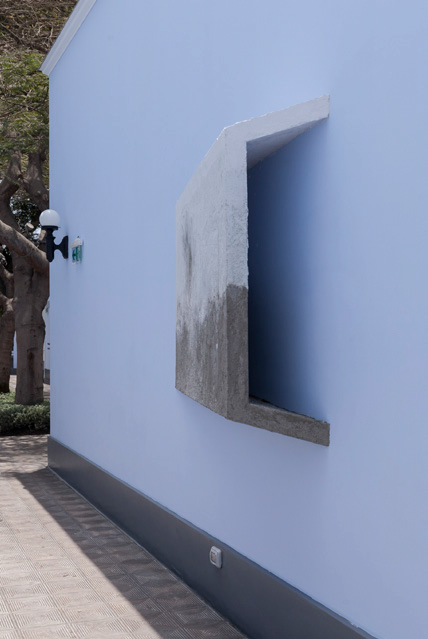
Site specific sculpture
Concrete, plaster, terrazzo.
280cm x 620cm x 320cm
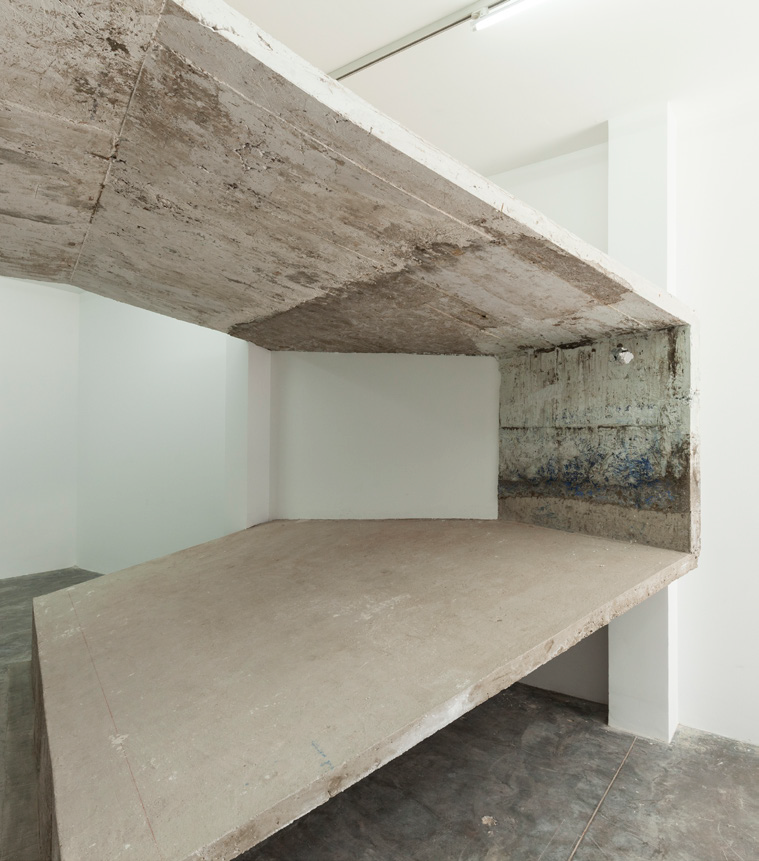
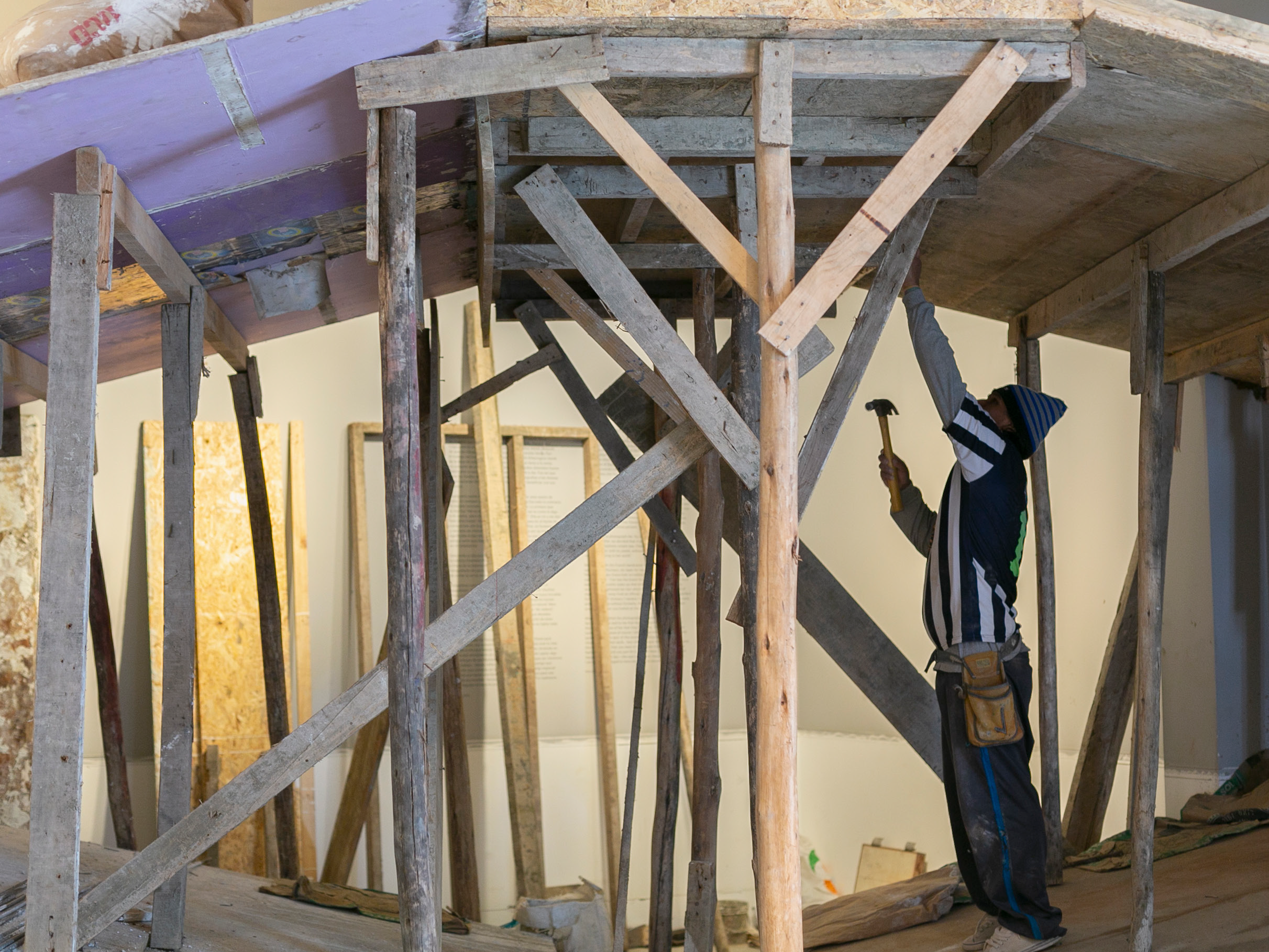
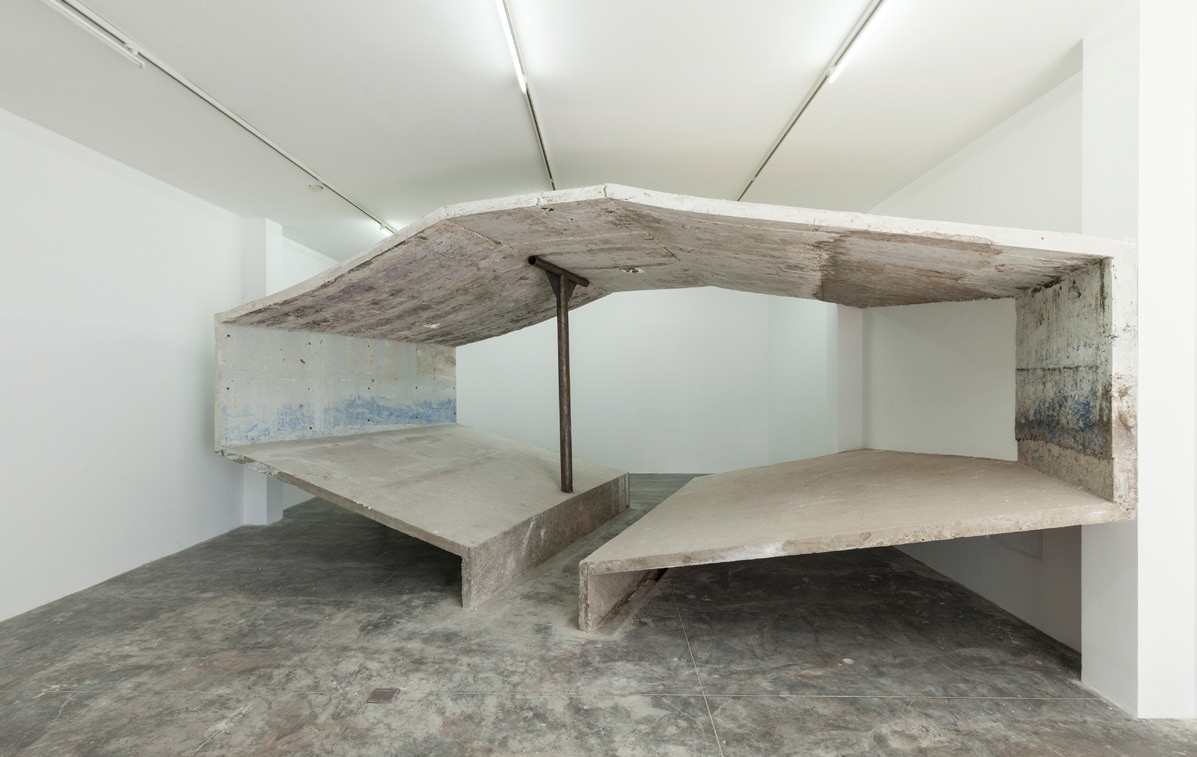
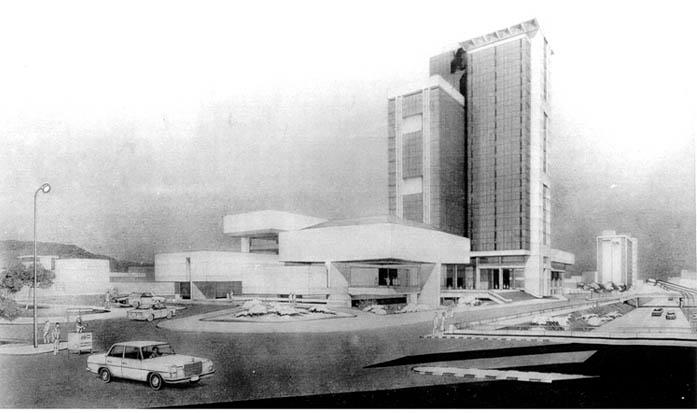
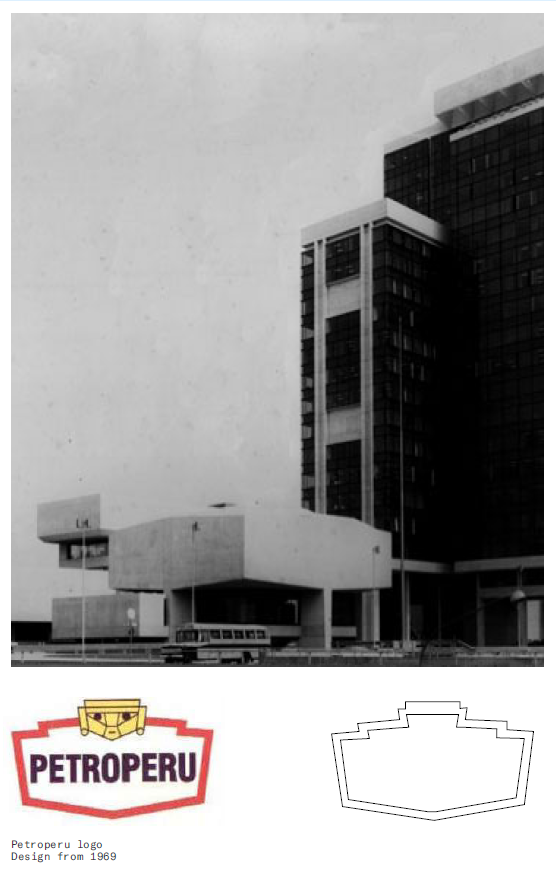
In Estratos, Miguel Andrade Valdez expands his inquiry into the relation between sculpture and architecture, turning his attention to a singular moment in architectural history: the post-war decades in Latin America, when largescale projects aimed to accommodate the growing bureaucracy of the modern state began to alter the region’s most prominent urban centers. Estratos takes as its point of departure the building that continues to serve as the headquarters of Petroperú, the state-owned petroleum company officially created in 1969, following General Velasco’s expropriation of the oilfields of the International Petroleum Company. Inside the gallery we see a fragment of the auditorium of the building, one of the most iconic representatives of the brutalist aesthetic that would come to define the architectural legacy of Velasco’s Revolutionary Government.
Brutalism was poised to be the style of choice for a state embarking on a project of national renewal. Its imposing structures, marked by an uncompromising refusal of ornamentation and a brazen display of materials in their raw or brute state, were intended to project the kind of strength that such a project demanded. Their interest in revealing rather than disguising the mechanisms whereby buildings regulate the flow of those who inhabit them, too, is revealing. It speaks of a desire to allegorize the functional efficacy ascribed to the bureaucratic apparatus that supported the emergent national myth.
Designed by Walter Webenhofer and Daniel Arana Ríos and finished in 1973, the Petroperú building is emblematic of these concerns and of the monumentality to which these projects aspired. This monumentality takes on a special meaning in Peru, particularly when measured against the rich architectural legacy of its pre-Columbian past, a past alluded to in the company’s logo which today crowns the structure. Andrade Valdez’s work has consistently explored the sculptural dimension of the various structures that make up Peru’s architectural patrimony in both its vernacular and official manifestations. But while his investigations have predominantly approached architectural forms as objects endowed with a latent sculptural potential, Estratos presents us with a fragment of a structure whose scale exceeds the dimensions typically assigned to objects. This fragment never quite ceases to be an architectural structure. Its limits exceed those of the gallery, effectively suspending the neutralizing operation conventionally performed by exhibition spaces when they act as containers for those objects that are granted the status of art.
Underlying the superimposition of two distinct institutional spaces—an= operation that deliberately contravenes the law that states that no two bodies shall occupy the same space—we find an attempt to probe the phenomenology of artistic reception. We have only to think of the neutralizing operation typically performed by the gallery as the condition for contemplation to see that what is suspended as this operation is suspended is the possibility of this habit. We are invited not to contemplate but to inhabit the sculpture. The gallery’s failure to enclose a distinct object illuminates for us, paradoxically but with uncanny efficacy, the primordial function of any enclosure, a function aligned with the procurement of shelter and thus with a kind of degree zero of architecture. In the end, though, the distinct contribution of a work like Estratos might lie beyond this concern with the phenomenology of artistic reception and with the boundary that separates sculpture from architecture. What we see emphatically affirms its own existence through its imposing rawness, but this rawness is inseparable from a temporal determination that ends up exposing the futility of any such affirmation. It is the rawness of matter as it lays bare the infinity of time.
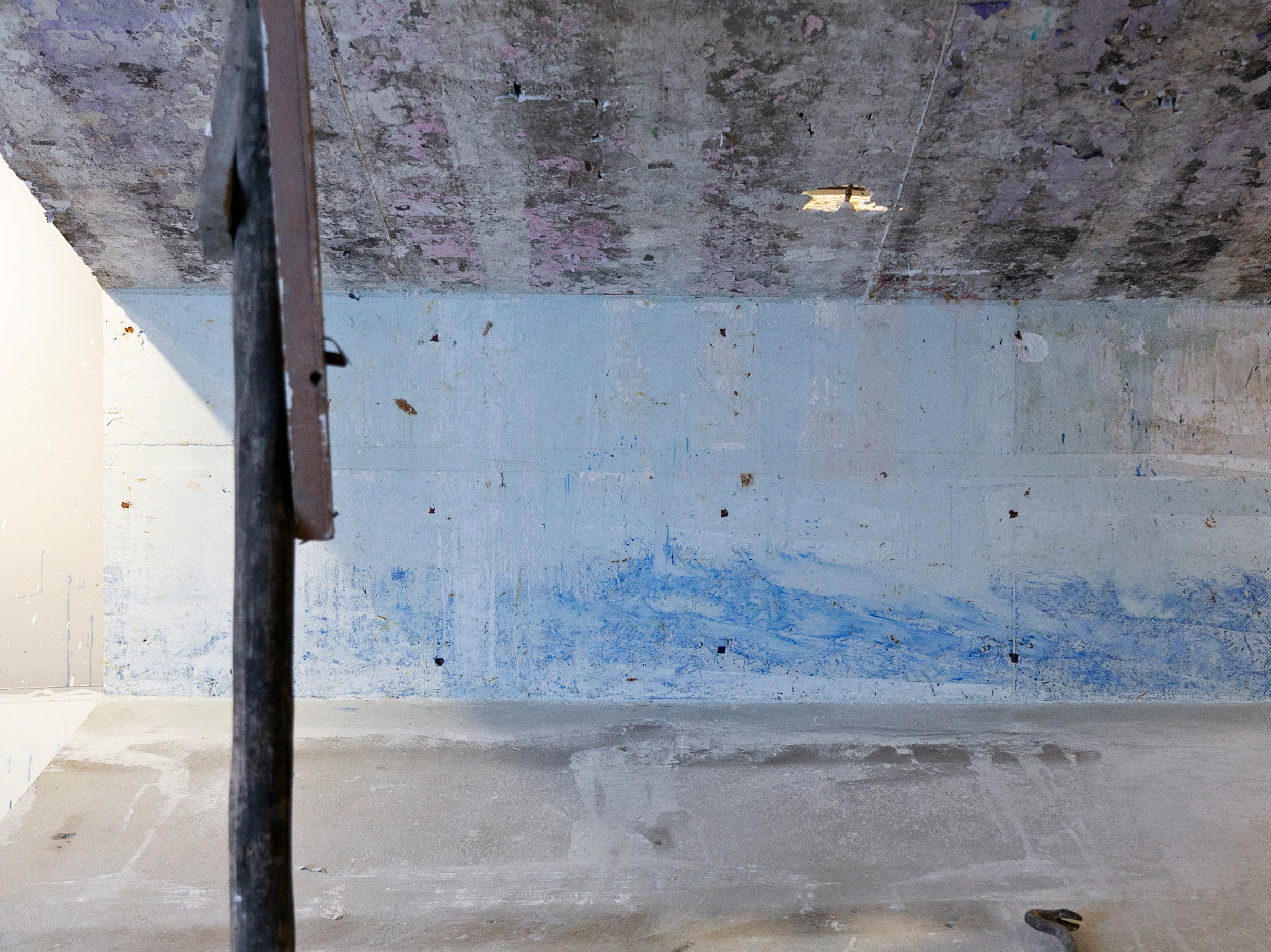
This more metaphysical dimension could seem unwarranted were it not for the strong presence of this infinity in the sedimentation present in the structure. Oil is a resource that xaframe of reference, one that necessarily exceeds any of the frames of reference supplied by human institutions, including of course those of a state erecting monuments to its own capacity to extract the wealth hidden in the deep strata of the earth. When one adopts this frame of reference, every human structure emerges as a ruin, bound as it is to crumble. And if that is the case then we ourselves cannot help but ponder our own dissolution. Estratos invites us to imagine a very distant future that is ultimately no different from the very distant past. It invites us to imagine a time when we do not exist.
Petroperú,1969
The Echo Project
Explore a curated collection of our past work, where imagination meets strategy. Each project reflects our drive to deliver thoughtful, effective solutions.
ESTRATOS
2016
Site specific sculpture
Concrete, plaster, terrazzo.
280cm x 620cm x 320cm